

In a period where the global energy market is already destabilized, Ukraine has targeted Russian Gazprom facilities
The scenario of oil prices skyrocketing to $300 is no longer considered a mere paper theory following successive strikes on critical energy infrastructure in the Middle East. "We warn the enemy that they made a big mistake attacking the energy infrastructure of the Islamic Republic of Iran, and our response has not yet ended," the Revolutionary Guards (IRGC) proclaimed. This follows Wednesday's Israeli strike on South Pars in Iran, the world's largest gas field. The subsequent Iranian retaliation was severe, with Tehran launching two attacks against Qatar's giant Ras Laffan LNG facility, striking the Habshan gas facility and the Bab field in the UAE, while also targeting Saudi Aramco's Samref refinery at the port of Yanbu and Kuwait's Mina Al-Ahmadi refinery.
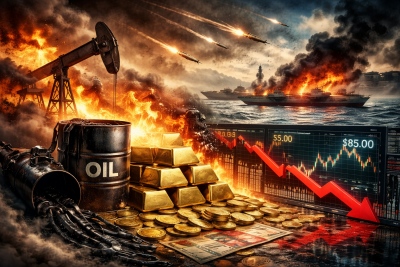
In response, US President Donald Trump threatened Tehran that he would "massively blow up" the entire South Pars gas field if Iran conducts any further retaliatory attacks on Qatari infrastructure. It is noted that today, Thursday (19/3/2026), Brent crude has risen by over 8% to $116, while natural gas has surged by up to 27% to 69 euros.
Surge in oil prices
Oil has increased by approximately 50% since the start of the war in the Middle East on February 28, which has caused chaos across the region, blocking the Strait of Hormuz and significantly reducing oil and gas production. "The market is still underestimating and not fully pricing in the risk of how quickly the situation can escalate into direct attacks on broader Gulf energy infrastructure," said Haris Khurshid, chief investment officer at Karobaar Capital LP in Chicago. "If such strikes occur, $120 will not be the ceiling but the starting point. Seeing $140 to $160 would not be unreasonable at all," he added, referring to Brent prices.
"Pressure on the Strait of Hormuz means that President Trump cannot simply declare victory and leave, as that will not solve the core problem," stated Will Todman from the Center for Strategic and International Studies. "Many of the options he has to increase pressure on Iran will push energy prices even higher, such as attempting to seize Kharg Island or attacking Iranian energy infrastructure."
Nightmare scenario for $300 oil
In recent weeks, the market has received an unprecedented shock. Data shows that West Asian exports fell from 25.13 million barrels per day in February to approximately 9.71 million in mid-March, with some estimates dropping the figure as low as 7.5 million. Essentially, in a very short period, about two-thirds of exports from a region covering one-fifth of global production disappeared. Simply put, one of the fundamental pillars of global supply went offline.
The issue is not only exports but also production. Due to restrictions on export routes and a lack of storage space, producers are forced to cut output. Estimates show:
-
Iraq: reduction of approximately 2.9 million barrels/day
-
Saudi Arabia: 2 to 2.5 million
-
United Arab Emirates: approximately 1.5 million
-
Kuwait: approximately 1.3 million In total, over 7 million barrels per day have been lost from production, with some estimates reaching 10 million—about 10% of global supply. These barrels do not simply return with the push of a button. In this context, some analysts "see" oil skyrocketing even to $300 per barrel, a figure considered unthinkable a month ago but now a realistic possibility. This is because when physical supply is absent, the market ceases to function on expectations and operates on panic.

Insidious 'strike' from Ukraine for energy chaos
To all this, an insidious move by Ukraine and Volodymyr Zelensky is added. At a time when the global energy market is already destabilized, Ukraine has targeted Gazprom facilities that supply Europe and Turkey. "New attacks on the export infrastructure facilities of PJSC Gazprom. During the period of March 17–19, an escalation of attacks on critical infrastructure ensuring gas exports through the TurkStream and Blue Stream pipelines is recorded," the company's announcement stated. Through coordinated actions of the Russian Ministry of Defense and mobile operational groups, the attacks were repelled and no facilities were hit. Specifically, attempted attacks involved:
-
22 drones at the "Russkaya" compressor station
-
3 at the "Kazachya" station
-
1 at the "Beregovaya" station
Speaking on February 24 at the FSB board, Russian President Vladimir Putin stated that there might be attempts to sabotage the TurkStream and Blue Stream pipelines, which run along the bottom of the Black Sea. Following this statement, Gazprom recorded a series of attacks on its infrastructure. It is noted that Russia supplies gas to Turkey via two pipelines crossing the Black Sea. Blue Stream became operational in early 2003, with a capacity of 16 billion cubic meters per year and a total length of 1,213 km.
The TurkStream export pipeline consists of two lines: one supplies Turkey and the other countries in South and Southeast Europe. Its total capacity is 31.5 billion cubic meters and it went into operation in January 2020. Today, TurkStream remains the only active route for Russian gas supply to Europe following the cessation of transit through Ukraine. The starting point of the pipeline is the "Russkaya" compressor station, built near Anapa.
www.bankingnews.gr






Σχόλια αναγνωστών